Mamy to! Pierwsza seria obrazów Jerzego Ruszczyńskiego już dostępna w naszej galerii.
 Cała seria to 12 obrazów, a w tym tygodniu pierwsze 6 prac.
 Prace dostępne na naszej stronie internetowej (link w BIO).


Dążenie do odkrywania związku pomiędzy tym co robimy, a rzeczywistością nas ogarniającą jest fundamentalnym zagadnieniem mającym swój początek w pytaniu:
Jak działa nasz umysł, po co i dlaczego?
Te pytania przedstawiane w formie graficznej mają dać nam odpowiedź na zagadnienia związane z egzystencją tu i teraz. To co będzie potem, a zarazem to co było przed nami zapisujemy tu i teraz poprzez zapis reakcji przyczynowo skutkowych, które jak sądzę łączą nas przeszłych i przyszłych. Czynię to z nadzieją pogłębienia wiedzy o naszym umyśle. Większość eksperymentów możemy przeprowadzać na swoim umyśle poprzez wytwarzanie form graficznych w obrazach rzeczywistych, w których poszczególne formy koegzystując ze sobą przedstawiają działanie reakcyjne, to znaczy takie jakie zachodzą w umyśle podczas realizacji obrazów rzeczywistych.
Obrazy rzeczywiste są fragmentami rzeczywistości zaczerpniętej z umysłu oraz otaczającej nas przestrzeni.
Przestrzeń zewnętrzna w połączeniu z naszym umysłem daje nam obraz działania zespolonego, a w wyniku tego działania powstaje obraz graficzny.
Ostatecznie dramatyczność takiego działania polega na ograniczeniu nas poprzez nasze nieuchronne związanie z tym co było przed nami i tym co nastąpi po nas. To upiorne związanie jest o tyle bardziej niepokojące, że nie jesteśmy w stanie poprzez byt uwolnić się z tego związku nas z rzeczywistością jak i nie jesteśmy w stanie oddzielić nas od tego co było przed nami i tego co będzie po.
Pocieszającym faktem w naszej egzystencji jest możliwość poprzez siebie poznawania, odkrywania i badania przeogromnych zasobów danych nam przez rzeczywistość.
Motto:
„ Musimy sobie uświadomić jedną podstawową rzecz, że my to nie my, że nie jesteśmy dosłownie sobą. Jesteśmy wynikiem powstawania nas w tu i teraz. Mamy za sobą cały szereg wypadków, które doprowadziły nas do chwili obecnej i jesteśmy jedynie ogniwem łańcucha łączącego nas z przyszłością…”
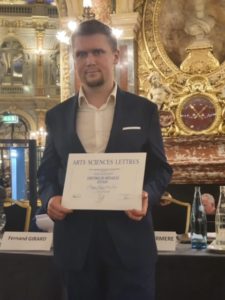
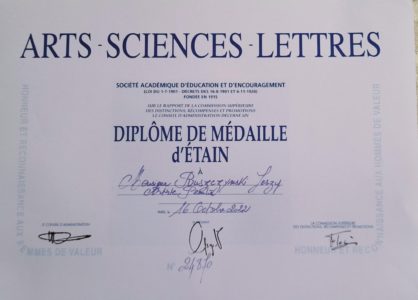
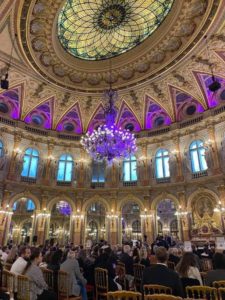
Założone w 1915 roku Towarzystwo Akademickie Arts-Sciences-Lettres działa pod patronatem prezydenta Republiki oraz Académie Française. Co roku Towarzystwo, przyznając nagrody, wyróżnia osoby wybitnie zasłużone na polach sztuki, nauki oraz literatury. Wśród laureatów tej prestiżowej nagrody są m.in. Louis Lumière, Sidonie-Gabrielle Colette, Sacha Guitry, Yehudi Menuhin, Olivier Messiaen czy Simone Veil.
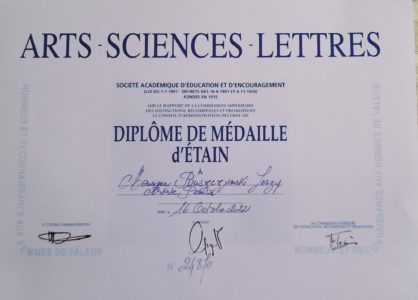
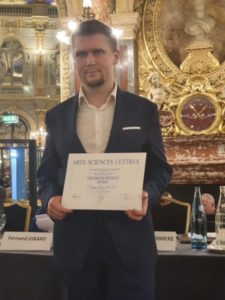
Do niedawna Towarzystwo nagradzało tylko Polaków związanych w jakiś sposób z Francją, takich jak Elżbieta Czerczuk, która prowadzi swój teatr w Paryżu. To się zmieniło w ub. roku, gdy złotymi medalami zostali wyróżnieni po raz pierwszy niezwiązani z Francją polscy artyści: wybitny malarz prof. Stefan Gierowski (zmarł w tym roku) oraz Leszek Sokół. Srebrny pozłacany medal otrzymał Jan Dobkowski. W roku 2022 złoty medal otrzymała malarka Agnieszka Nowińska, pozłacany Wojciech Kowalczyk, srebrny Jerzy Plucha i Karolina Jaklewicz, a cynowy Jerzy Ruszczyński.
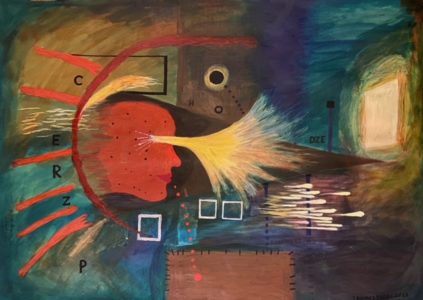
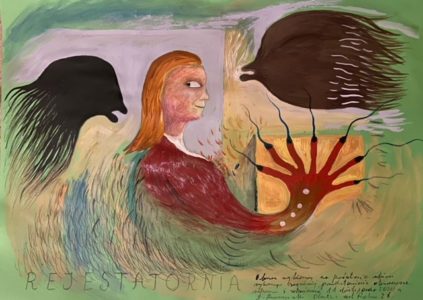
Space-time shift 2022

Private Collection England.
The general appearance of the presented image can be compared to two components, an organic element and a material element.
An organic element exposed as a form of an entity acting on reality by its dismemberment with an interaction acting before the movement in the horizontal direction of deviation from right to left. Rectangular material elements in the shapes of simple geometric figures.
The mental reaction simply responds to sight with a bright color tone with one of the geometric figures. Color marking of individual forms of the most important artistic forms: carmine – as an organic element, other colors as material elements.
The background of the image-reality, a horizontal line, and individual additional elements, including three rectangles, bright figurative elements of the microworld rushing towards the levels, a brown form with black connectors and a colorful background with letters forming the word P R Z E C H O D Z E. space-time existential movement. Numbering 1,2,3,4,5,6,7,8 organic 1,2,3,4,5,6,7,8 material. Generally speaking, the image is an attempt to present an autoorganic being in displaying space-time reality on the basis of a specific individual situation.
Painting was done on the basis of a sketch as a real situation remembered during a visit to the registration office. During the recording, the reactions taking place between individual organisms evoked specific artistic forms in the minds of the participants. Two graphic forms appearing as supplicants, the form of the figure recorder in the central part of the painting against the background of a gray wall is the closest to reality. The 7 fingers of the registering hand were moved in time, increasing the number based on psychophysical reactions occurring one after the other at a certain time. Numbers 1,2 indicate the characters of petitioners. The Seven-Finger Hand Reaction took place on November 11, 2022 between 1:00 PM and 1:30 PM Eastern European Time.
Mistrzu, Chciałam Pana poinformować ,ze otrzymał Pan nagrodę francuskiej Akademii Sztuki, Nauki i Literatury.
Uroczystość wręczenia nagród odbyła sie16 października w Paryżu. Nagrodę odebrał w Pana imieniu Pan Max Gielniewski.
Proszę przyjąć wielkie GRATULACJE
The image was made on the basis of a quadruple method inspired by it
1. Direct action
2. Painting by Albrecht Durer
3. Bible 1000 years-6 days
4. Intuitive Action (plastic forms in the form of yellow fire circles placed on the bodies of the characters)
———————————————————————————————–
1. Direct action consisting in reproducing the authentic figures of a woman and a man lying down on a cardboard, consisting in outlining the figures on a 1: 1 scale.
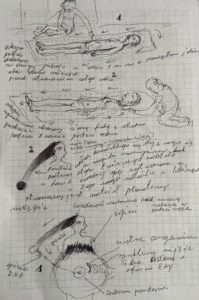
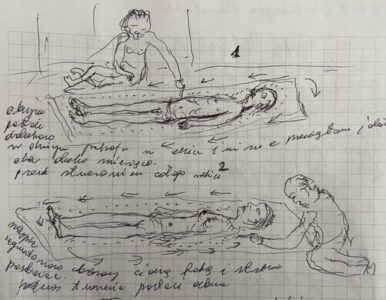
2. The layout of the characters is based on the layout used by Albrecht Durer
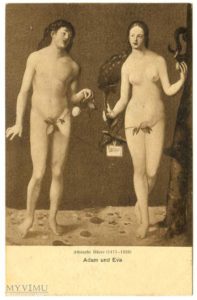
3. Application of the body created from the earth on the basis of the biblical text, green forms on the bottom coming out of the ground – the beginning of life, 6 black points as signs on the bodies of the figures.
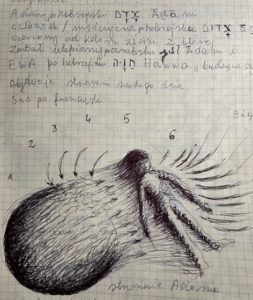
Taking out a fragment of Adam’s body in the rib and creating from this fragment of Eve’s body – red forms passing from Adam’s body to Eve’s body.
In the Hebrew ADOM, man from green to red from the color of the earth from which he was made, Eve-Hawwa-awakening to life, both created on the sixth day.
As the primary explanation of the tempting Satan in the form of a serpent divided into two parts, just like the twigs from which the symbolic apple of knowledge is torn, the liberation of consciousness, which liberates humanity in man as the dominant species on earth.
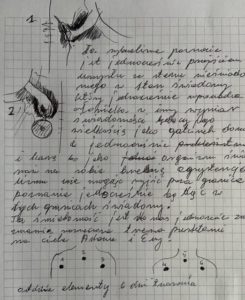
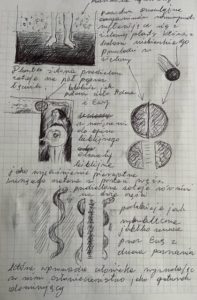
Symbolic knowledge of good and bad is at the same time the transition of the mind from the unconscious state to the conscious state, which triggers existentialism as a punishment and a burden borne in a man who is not able to penetrate to the end and understand the meaning of existence and his existence and being.
The bully and suffering of existence is the punishment for breaking a warning.
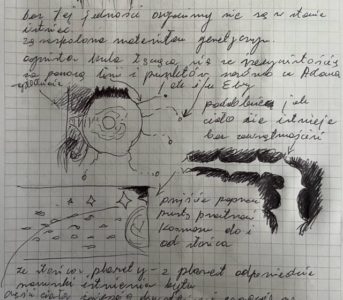
4. Intuitive operation – yellow and red forms placed on the characters with additional elements
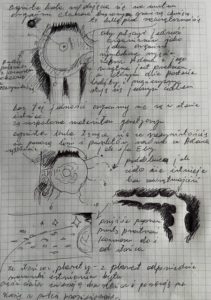
a. A form of a red DNA helix extending from a blue planet into a central white point in the form of Adam
b. red rays coming from the head – awakening consciousness-mind in Adam and Eve.
c. the yellow forms emerging from the two large forms connect the bodies to the cosmos, as do the deformed bodies of Adam and Eve.
d. link-sun as the primary cause of emergence – reaction and union with the whole.
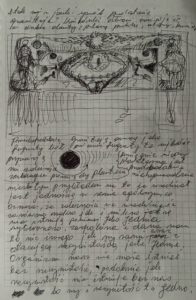
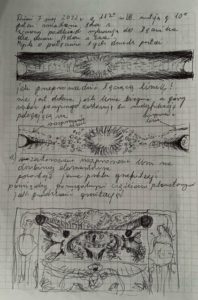
And awareness is our blessing and a curse at the same time.
The man’s consciously changed face into a self-portrait, in which the gaze directed towards the viewer asks:
isn’t it a wonderful gift given to us that we can consciously see,
or is it just an illusion?
For us, is the plucked fruit of a tree not only a dark force with only a boundless emptiness behind it?